Forearm and Grip Training for Aesthetic Arms: The Complete Guide
The complete guide to building aesthetic forearms and grip strength, with exercises, programming, and the science behind forearm development.

Why Your Forearms Are the Most Underrated Aesthetic Muscle
Most guys spend all their gym time chasing bigger biceps and chest, completely ignoring the two muscles that are visible every single day: your forearms. Think about it. You can cover your chest with a shirt, but your forearms are exposed in a t-shirt, a button-down rolled at the sleeves, and even a suit. They are the visual bridge between your hands and your upper arms, and if they look like twigs, your entire arm aesthetic falls apart. Skinny forearms on a developed upper body is the fitness equivalent of a nice car with cheap rims.
Beyond aesthetics, grip strength is one of the most functional metrics of overall fitness and even longevity. Research consistently shows that grip strength correlates with overall health outcomes, cardiovascular fitness, and mortality risk. A strong grip means strong connective tissue, healthy tendons, and a neuromuscular system that fires efficiently. When your grip is weak, everything else suffers. Your deadlift stalls, your pull-ups suffer, and your rowing capacity tanks. Grip is the bottleneck most guys never address until it becomes the limiting factor in their training.
The forearm is composed of over 20 muscles that control wrist flexion, extension, pronation, supination, and finger movement. This complexity means you need a variety of exercises to fully develop the region, not just wrist curls. The brachioradialis, which runs along the top of your forearm, is the most visually prominent muscle and responds well to heavy loading. The flexors on the underside create thickness and vascularity. The extensors on top contribute to the three dimensional look when your arm is relaxed. Training all of these creates forearms that look like they belong to someone who actually lifts, not someone who skips arm day.
The Exercise Protocol: Building Thick, Vascular Forearms
Direct forearm training should be treated with the same intensity and progressive overload as any other muscle group. Twice a week, after your main upper body work, dedicate 10 to 15 minutes to targeted forearm training. Here are the core exercises, organized by function.
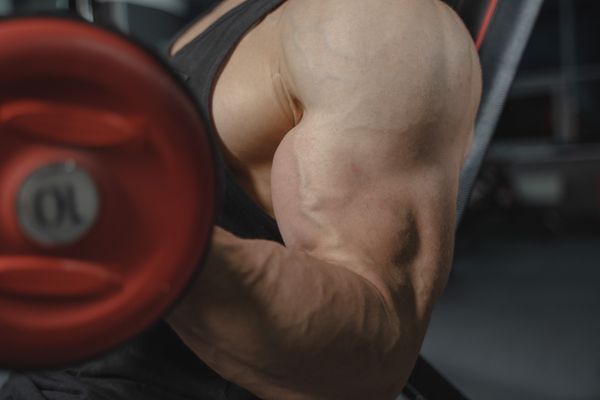
For brachioradialis development, reverse barbell curls and hammer curls are your primary weapons. The brachioradialis is most active when your wrist is in a neutral position, which is exactly what a hammer grip provides. Load a straight bar or EZ curl bar with moderate weight and perform reverse curls, palms facing down. Control the eccentric for two seconds. This is not an ego lift. Go heavy enough to challenge the muscle but light enough to maintain strict form. Four sets of 10 to 12 reps, twice a week. Hammer curls with dumbbells are equally effective and also build the biceps brachialis, which adds width to the upper arm when viewed from the side.
For forearm flexors, wrist curls are the classic and they still work. Sit on a bench, rest your forearms on your thighs with your wrists hanging over your knees, and curl a dumbbell or barbell using only wrist movement. Keep the reps high, 15 to 20 per set, and focus on the squeeze at the top. The flexors respond well to volume and time under tension. Behind the back barbell wrist curls are another option that provides a slightly different angle of resistance and keeps constant tension on the flexors throughout the movement.
For forearm extensors, reverse wrist curls are the go to. Same setup as wrist curls but with your palms facing down. Most guys neglect the extensors entirely, which leads to imbalances and a forearm that looks flat from certain angles. The extensors are smaller muscles, so use lighter weight and higher reps. Three sets of 15 to 20 reps per session.
For grip and overall forearm development, heavy deadlift holds, farmer walks, and plate pinches are essential. Load a barbell to your deadlift max or slightly above, and simply hold it at the top of a deadlift for 20 to 30 seconds. This builds isometric grip strength and forces every muscle in your forearms to fire simultaneously. Farmer walks with heavy dumbbells or kettlebells do the same while also building your traps, core, and conditioning. Plate pinches, where you hold two smooth sided weight plates together with your fingers, are brutal for developing pinch grip strength and finger flexor endurance.
Programming Forearms Into Your Training Split
The most common mistake guys make is treating forearms as an afterthought, doing a few sets of wrist curls at the end of a workout when they are already exhausted. That approach gives you exhausted effort, not maximum effort. You need to program forearm training strategically.
If you train upper body twice a week, add forearm work to both sessions. Session one focuses on brachioradialis and flexors: reverse curls, wrist curls, and deadlift holds. Session two focuses on extensors and grip endurance: reverse wrist curls, farmer walks, and plate pinches. Each session should take no more than 15 minutes. Quality over quantity.
Progressive overload applies to forearms just like every other muscle. Add weight when you can complete all prescribed reps with good form. Track your numbers. If you are wrist curling 30 pounds for 15 reps this month, aim for 35 pounds next month. The forearms recover quickly because they are used to constant low level work throughout the day, which means you can train them frequently without overtraining. Twice a week is the minimum. Three times is fine if you vary the exercises and intensity.
Avoid training forearms immediately before heavy pulling movements like deadlifts or rows. Fatigued grip will compromise your performance on the big lifts. Either train forearms after your main workout or on a separate day entirely. Grip-intensive exercises like deadlifts and rows already provide significant forearm stimulation, so your direct work supplements rather than replaces what you get from compound movements.
Nutrition, Vascularity, and the Aesthetic Finish
Thick forearms look good. Thick, vascular forearms look elite. Vascularity is a function of two things: muscle size and body fat percentage. You need enough muscle to push the veins toward the surface, and low enough body fat to make them visible. If you are above 15 percent body fat, your forearm veins will be buried under a layer of subcutaneous fat regardless of how much you train them. Getting lean is the single most effective thing you can do for forearm aesthetics.
On the nutrition side, adequate protein intake supports muscle growth in the forearms just like everywhere else. Aim for at least 0.8 grams of protein per pound of body weight. Creatine monohydrate can also contribute to fuller looking muscles by increasing intracellular water retention within the muscle cells. Staying well hydrated keeps your blood volume up, which enhances vascularity during training. A temporary pump from nitric oxide boosters like citrulline malate can make your forearms pop during a workout, but real vascularity is built through consistent training and low body fat over time.
One more thing: stop using lifting straps on every exercise. Straps have their place for maximal deadlifts or heavy shrugs, but if you use them for every set of rows and pulldowns, you are robbing your forearms of the grip work they need to grow. Train your grip raw as much as possible. Let your forearms fail before your back does on pulling movements. That is how you build a grip that matches your frame. Your forearms are the most visible muscle on your body outside the gym. Start training them like it matters, because it does. A guy with thick, vascular forearms and a crushing handshake projects strength without saying a word. That is the aesthetic edge most guys leave on the table. Pick it up.